
Town of Ossining Resident Lookup Sources
A resident lookup is a way to test a narrow fact through the office that keeps that type of record. Parcel data can identify the owner named on a dated property record, but an owner is not necessarily the occupant. The voter-status tool answers an individual registration question under election rules. Court portals identify a party or case trail only when the court and case type participate. Historical vital indexes and archival sources offer time-bounded family leads, while state business and license databases describe a public filing or credential rather than a private residence.
| Record | What it can confirm | Official route | Access limit |
|---|---|---|---|
| Parcel or tax roll | Owner-of-record and a dated parcel connection | AxisGIS or Westchester GIS | The named owner may be an estate, trust, entity, or mailing contact. |
| Voter status | Registration and voting-information functions | NYS voter lookup | Individual lookup only, with required identifying fields and use limits. |
| Court case | A party role in a dated public case | WebCivil/eCourts, NYSCEF, or the clerk | Coverage is partial; sealed and protected matters are not ordinary results. |
| Vital-record lead | A historical birth, death, or marriage index lead | NYS Department of Health or State Archives | Certificates have eligibility rules and are not available through FOIL. |
| Business or license filing | A public organization, license, or filing affiliation | NYS Department of State | A filing address or entity role does not prove where a person lives. |
Start with the source closest to the fact in hand. A historic family question may belong with the State Archives, WCHS, or County Archives. A court-number question belongs with the court system or clerk. A property connection should keep its parcel identifier, municipality, and roll year intact. This method prevents an official record from being given a meaning it does not support.
Town of Ossining Resident Lookup Courts
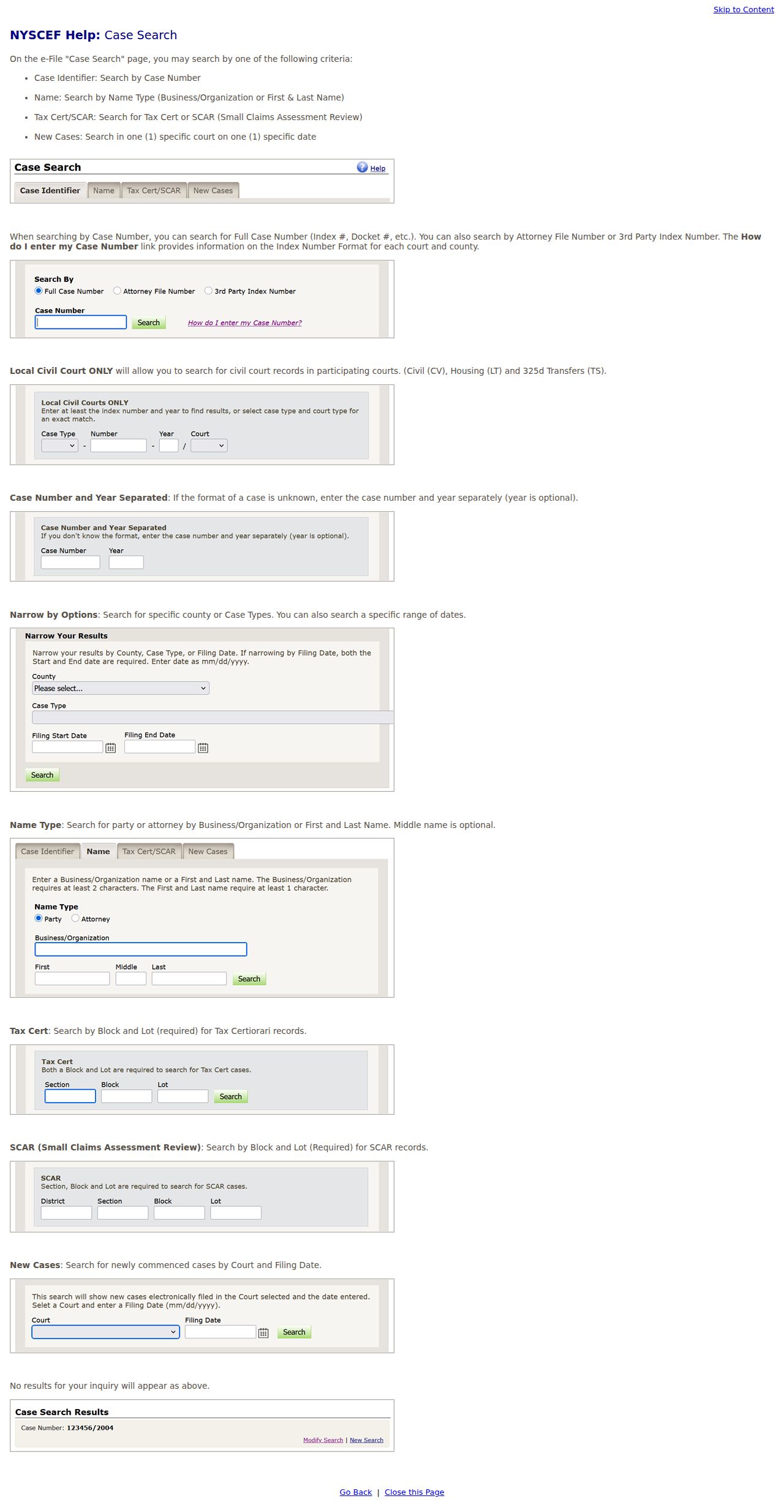
Court results can verify that a named party appears in a dated public matter, but they do not create a general resident directory. NYSCEF case-search help documents Case Identifier, Name, Tax Cert/SCAR, and New Cases modes. The name mode separates business or organization names from first, last, and middle-name fields and can be narrowed by county, case type, date range, or party or attorney role. Tax Cert/SCAR uses Block and Lot, while New Cases requires a court and filing date.
| NYSCEF mode | Fields or filters documented | Useful result context |
|---|---|---|
| Case Identifier | Full index or docket number, or separate number and year | Confirms the matter to request from the right clerk. |
| Name | Business or organization, first, last, middle, party or attorney role | Separates names that otherwise look alike. |
| Tax Cert/SCAR | Block and Lot | Connects a designated local civil matter to a property key. |
| New Cases | Court and filing date | Limits the inquiry to a filing window. |
The official NYSCEF case-search help is the source for the documented search modes.
WebCivil/eCourts offers current and disposed civil-case information where a court participates, yet the online display is not the full file. For a local matter, the Westchester court guide identifies the Ossining Town Justice Court. No standalone public Town Justice docket portal was found; contact the clerk at (914) 762-8562 or OssiningTownCourt@nycourts.gov and ask about the case number, date, records category, copy route, fee, and restriction.
Town of Ossining Resident Lookup Checks
A same-name result needs independent anchors before it can be connected to a particular person. Compare the municipality, record date, middle initial, party role, parcel or SBL when relevant, and case caption or document type. The Town of Ossining, the Village of Ossining, Briarcliff Manor, and nearby postal labels should not be collapsed into one location. Briarcliff Manor spans the Town of Ossining and the Town of Mount Pleasant, so a postal address alone does not settle jurisdiction.
Use a compact verification path: name variant plus date plus place, then a second official record that answers a different question. For example, a dated court docket can be compared with the county named by the court and a related parcel or instrument only where that connection is actually shown. Do not merge a matching surname from a court result, a registry result, and a historical index. Each system has a separate purpose and may concern different people.
Note: Record the source URL, agency, date, and result type before drawing any conclusion from a matching name.
Town of Ossining Resident Lookup Voter Status
The NYS voter lookup is an individual registration-status tool, not a bulk people directory. The inspected form asks for last name, first name, date of birth in MM/DD/YYYY format, county, and ZIP Code; required fields are marked, and the site requires cookies and JavaScript. Westchester County is available in the county menu. The state describes the tool as a route for registration, polling-place, and mail-ballot information.
New York Election Law makes registration records public with exclusions for sensitive fields, while the Board of Elections warns that registration information may not be used for non-election purposes. Do not publish a voter-file list or treat a no-result response as proof that a person does not live in the Town of Ossining. For election-history material, use the appropriate county board or municipal clerk and identify the election district, year, and record type in a focused request.
Verifying Town of Ossining Resident Records
Verification means confirming a record's limited fact, not assembling a broad profile. Begin with a name plus a dated municipal or county context. If a property connection is relevant, preserve the parcel or SBL, municipality, and roll year from the official property route. Then use a court or archive record only when it has a matching date, role, or document reference. The custodian remains the source for an image, copy, or correction.
- Write down the exact name form, time period, and Town, Village, or other municipality connected to the question.
- Use the official source that keeps the relevant record, such as a parcel route, court portal, archive index, or vital-record route.
- Compare a second, independent record by date, county, parcel, case number, or other non-sensitive identifier the agency lawfully displays.
- For a needed document, contact the clerk, registrar, or archive and request the defined record rather than relying on an index screen.
- Docket
- The court's running record of a case and its filed events. It is not necessarily the complete case file.
- Index and image
- An index helps locate a record; an image or clerk copy is the document itself and may have separate access rules.
- Certified copy
- A copy authenticated by the custodian for the purpose and access route that office allows.
Town of Ossining Resident Lookup Family Leads
Family research uses different custodians for different relationships. A possible heir trail belongs with Surrogate's Court or County Archives estate records. A former classmate is better approached through yearbooks, library or historical-society collections, and alumni resources. A birth-parent question follows New York's confidential adoption and birth-record channels, not an open name search. These routes are narrower, but they preserve the distinction between a historical family clue and a current identity claim.
For older vital leads, the State Archives indexes can provide name, date, place, and certificate number after the applicable waiting period, while the certificates remain with the Department of Health or local registrar under eligibility rules. The DOH genealogy form is a mail/PDF request, not a public name database. It includes event-specific fields and a $22 genealogy search fee that covers an uncertified copy or no-record response; birth and marriage genealogy requests require the stated deceased-person certification.
Town of Ossining Resident Lookup Limits
Some official systems are specialized status tools, not residence evidence. DOCCS Inmate Lookup requires a complete name and birth date, or a DIN when known, and may show current custody or facility information. The DCJS registry publishes legally defined Level 2 and Level 3 information online, with Level 1 information handled by phone. Neither result establishes a Town of Ossining residence, and neither should be combined with a same-name court result without independent identifiers.
Vital records are not FOIL records. Court matters can be sealed or protected. Voter records exclude sensitive identifying fields. The New York Address Confidentiality Program provides a substitute mailing address and mail forwarding for eligible participants, while covered agencies protect the actual address under its rules. Never try to reconstruct a protected location by comparing government records, parcels, tax bills, or family material.
Lawful use. Use a Town of Ossining resident lookup only for a personal, lawful record question. Stalking, harassment, intimidation, and efforts to expose protected information are prohibited.
For an error, contact the office that created or keeps the record and provide the source date, disputed field, and supporting official document. Keep corrections narrow and avoid supplying unnecessary sensitive details. A source that remains ambiguous should stay ambiguous rather than being assigned to the most likely name match.
Town of Ossining Resident Lookup Requests
FOIL is a route for defined agency records when a dedicated source does not answer the question. A request should name the department, record type, date range, Town or Village geography, case or parcel number when known, and preferred format. The Village records-access policy governs its local process. New York's Open Government guidance says an agency generally responds within five business days with a grant or denial, or an acknowledgement and approximate date.
Ask the custodian to identify the basis for any withheld category and to release separable portions where appropriate. Ordinary paper-copy charges are generally capped at $0.25 per page up to 9 by 14 inches unless another statute applies, so confirm any special fee before work begins. A narrow request can seek a record category; it cannot require a custodian to create a bulk personal dossier or disclose a protected record.